Twice-Exceptional (2e) Program for
Gifted Children
Understand the Gifted Strengths and Learning Differences Behind Your Child’s Potential
Our twice exceptional child program helps families understand both sides of their child’s profile; where they show gifted potential and where learning, attention, or developmental differences may affect their progress.

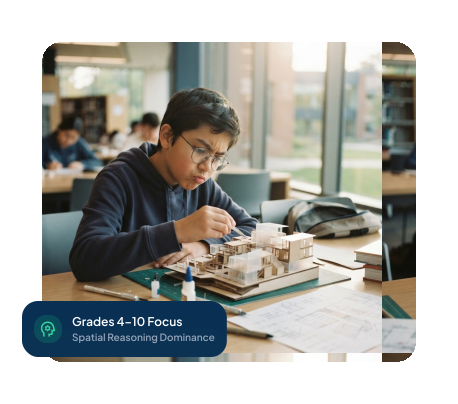
"For the first time, an assessment explained why our son was both brilliant and overwhelmed at school."
What is Twice-Exceptional (2e)?
A child is considered twice-exceptional, or 2e, when gifted ability exists alongside a learning, attention, or developmental difference. ADHD, dyslexia, autism, dysgraphia, and executive functioning difficulties are some examples.
This is the simplest way to understand the twice exceptional definition: significant strengths and specific challenges can exist in the same child.
Parents often first notice a mismatch between what their child seems capable of and what they consistently manage at school. Their child may solve complex problems but struggle to organize schoolwork, express advanced ideas verbally but find writing difficult, or excel in one subject while needing considerable support in another.
This uneven profile is one reason twice exceptional students can be overlooked or misunderstood. Strong abilities may hide learning difficulties, while academic struggles can make gifted potential harder to recognize. MyGiftedness looks at the complete profile so families can see where their child excels, where support is needed, and what those differences mean for their learning.
Signs Your Child May Be Twice-Exceptional
There is no single pattern shared by all twice exceptional children. Parents often notice a clear gap between what their child understands and what they consistently produce at school.
Advanced thinking with inconsistent performance across academic subjects
Strong creativity with difficulty completing routine academic tasks
Complex problem-solving with difficulty managing everyday organizational tasks
High curiosity with difficulty maintaining attention during lessons
Strong verbal ability with difficulty reading or writing
Exceptional abilities with significant challenges in other subjects
Original ideas with frustration during structured classroom activities
Rapid understanding with difficulty completing everyday school assignments
Why Twice-Exceptional Students Need Specialized Support
Traditional support can miss the needs of a 2e learner when it focuses only on academic difficulty or only on gifted ability. Effective twice exceptional gifted education recognizes both.
Challenge Advanced Abilities
Gifted strengths need sufficient depth, complexity, and intellectual challenge to remain active and engaged.
Address Individual Learning Needs
Specific strategies support attention, organization, reading, writing, executive functioning, and other areas of difficulty.
Recognize Uneven Development
A child can demonstrate exceptional ability in one area while requiring significant support in another.
Lead With Strengths
A strength-based approach gives children opportunities to use their strongest abilities while developing weaker areas.
Support Emotional and Social Needs
Appropriate guidance can address frustration, confidence, perfectionism, self-awareness, and difficult classroom experiences.
Our Twice-Exceptional (2e) Program For Giftedness
Our twice exceptional student program starts with the complete child rather than a diagnosis, school grade, or isolated difficulty. Highly researched gifted assessment findings guide learning priorities, suitable enrichment, individual support, and progress reviews.
Comprehensive Giftedness Assessment
Identifies cognitive strengths, learning patterns, gifted potential, and areas that may require additional support.
Personalized Learning Plan
Sets individual priorities around advanced abilities, learning needs, interests, and current development goals.
Strength-Based Learning Approach
Uses the child's strongest abilities to maintain challenge, engagement, confidence, and meaningful academic progress.
Individualized Support Strategies
Provides practical strategies suited to the child's learning differences, strengths, and response to challenge.
Ongoing Progress Monitoring
Reviews development regularly so learning goals and support strategies remain relevant as needs change.
How Our Program Supports Twice-Exceptional Children
Our 2e program for gifted children gives advanced abilities room to develop while addressing the learning differences that can make school difficult.
Personalized Learning Pathways
Personalized learning goals reflect the child's abilities, interests, challenges, and their individual cognitive profile.
Enrichment for Gifted Abilities
Advanced activities for gifted capabilities provide suitable depth for reasoning, creativity, curiosity, and complex problem-solving.
Support for Learning Differences
Focused strategies address difficulties that are affecting attention, organization, literacy, participation, or independent learning.
Flexible Learning Strategies
Methods can change according to the child's pace, learning preferences, and response to different tasks.
Parent Collaboration
Families receive clear insights, practical recommendations, and guidance for supporting development outside program sessions.
Benefits of Our Twice-Exceptional Program
A strong twice exceptional child program should never ask families to choose between developing giftedness and addressing learning difficulties. MyGiftedness considers both when planning the child's support.
Why Choose MyGiftedness?
MyGiftedness focuses on understanding how giftedness and learning differences interact within the same child. We use cognitive profiling, individualized guidance, and strength-based development to give families clear, practical direction.
Expertise in Gifted and 2e Education
Our approach recognizes the distinct cognitive and learning profiles commonly seen in twice-exceptional children.
Personalized, Research-Informed Approach
Recommendations reflect established giftedness research alongside each child's individual assessment findings and learning profile.
Strengths and Support Needs
Gifted potential receives focused development while specific learning difficulties receive appropriate attention and practical support.
Collaborative Family Guidance
Parents receive clear insights and practical recommendations for supporting their child's learning and development consistently.
Long-Term Potential Development
Support evolves with the child as abilities, learning needs, confidence, interests, and goals continue changing.

See your child’s gifted strengths and learning needs more clearly with MyGiftedness