Why it's necessary?
Recognizing giftedness at an early stage is crucial for helping children with exceptional abilities
thrive in every aspect of their lives. Early identification allows parents, teachers, and caregivers to provide
the right blend of academic challenge, emotional understanding, and social support that gifted learners need.
These children often think, feel, and process the world differently — and acknowledging their unique potential ensures that
their talents are nurtured rather than overlooked.
When we take the time to understand their learning styles, interests, and sensitivities, we create environments
that stimulate curiosity, encourage creativity, and build confidence. Such spaces not only help gifted learners reach
their highest potential but also foster a sense of belonging and self-worth.
Ultimately, recognizing giftedness early benefits everyone involved — it empowers families and educators with the awareness
and tools to guide these young minds toward balanced, joyful, and meaningful growth, both inside and outside the classroom.
 Stages of MyGiftedness: Integrated Developmental Framework
TGifted children can express their abilities in many ways, sometimes subtly. Common signs include:
Why MyGiftedness is Essential in Gifted Development
Giftedness isn’t just about high IQ or talent — it’s about the structure and balance of underlying cognitive abilities.
Energia SOI (Structure of Intellect) identifies and strengthens over 90 cognitive abilities across three dimensions:
Stages of MyGiftedness: Integrated Developmental Framework
TGifted children can express their abilities in many ways, sometimes subtly. Common signs include:
Why MyGiftedness is Essential in Gifted Development
Giftedness isn’t just about high IQ or talent — it’s about the structure and balance of underlying cognitive abilities.
Energia SOI (Structure of Intellect) identifies and strengthens over 90 cognitive abilities across three dimensions:
Operations
(thinking processes like evaluation, comprehension, creativity)
1
2
Contents
(types of information such as symbolic, semantic, behavioral)
Products
(ways information is organized — units, classes, relations, systems, transformations, implications)
3
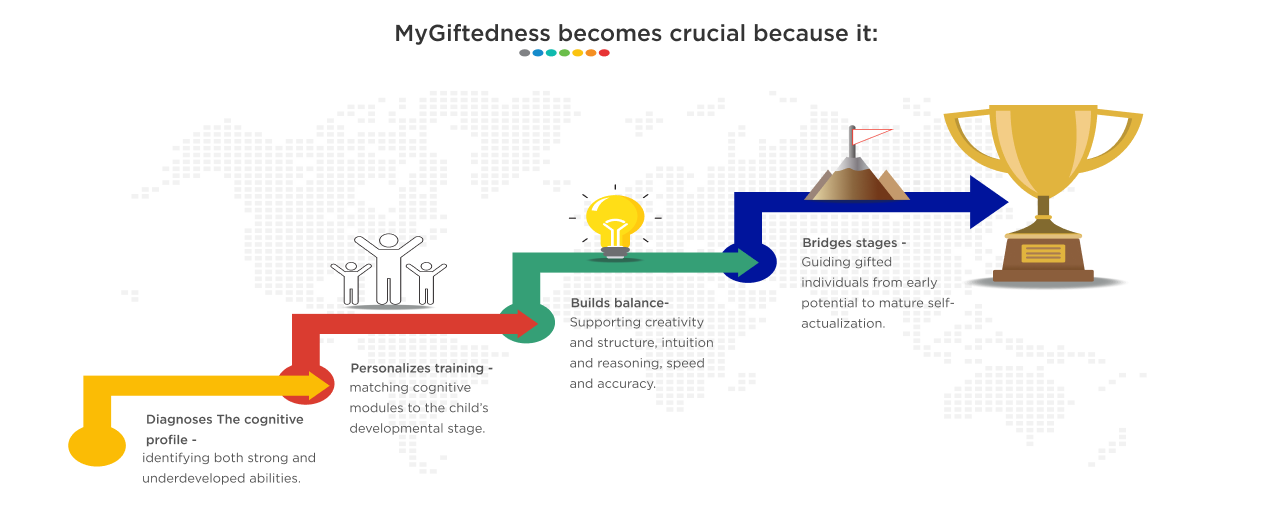

Gifted Stages + MyGiftedness Focus
Early Potential
Gifted Development Traits
Rapid learning, early curiosity, strong perception & memory
Challenges
Overstimulation, social mismatch
MyGiftedness Integration: Focus & Purpose
Foundation: Perceptual & Comprehension training Important: Builds early cognitive control, attention, and adaptive flexibility to channel natural intensity into learning stability.
 Cognitive imbalance:
Some abilities far exceed others, causing uneven learning or frustration.
Cognitive imbalance:
Some abilities far exceed others, causing uneven learning or frustration.
 Emotional overload:
Sensitivity and perfectionism can lead to anxiety or withdrawal.
Emotional overload:
Sensitivity and perfectionism can lead to anxiety or withdrawal.
 Underachievement
Bright students may lose motivation if not cognitively challenged.
Underachievement
Bright students may lose motivation if not cognitively challenged.